In August this year, I travelled to Busan, South Korea to participate in APIGA 2025. It was an incredible experience and a great opportunity to learn more about the world of internet governance. There were so many other young people from all across the world, from Japan to Mongolia, and it wonderful to be able to hear all of their diverse opinions, stories and backgrounds. I was also able to deepen my knowledge of the world of internet governance, thanks to the many experts who generously volunteered their time to share their knowledge, advice and thoughts on the current state of internet governance.
APIGA 2025: The Sequel
This all started back in 2024, when I stumbled upon APIGA Australia 2024. As discussed in that linked article, I very much enjoyed my experience, and I was excited to hear that there was, in fact, a ‘regional’ version of APIGA Australia. Rather than drawing on participants from different parts of Australia, the regional APIGAs have participants from all over the Asia Pacific region. What I didn’t know, however, was that auDA selected top participants from APIGA Australia to send to the regional APIGA on a full fellowship. I was fortunate enough to be selected last year and thus in August this year, I packed my bags and headed to Busan, where APIGA 2025 was held.
The Program
Regional APIGA vs Local APIGA
The format of the regional APIGAs are fairly similar to the local APIGAs, as the local APIGAs, including APIGA Australia, try to follow the format of the regional one. APIGA 2025 ran over five days, where the first four days were full of workshops, activities and talks and the fifth day was mostly dedicated to the Model ICANN conference.
You can actually see what the full program looked like on the APIGA 2025 Confluence page.
Days 1–4: Preparation
Much like APIGA Australia 2024, the first four days were jam-packed with activities run by the mentor-experts (folks who actually work in internet governance) that were designed to teach us about various aspects of internet governance. Topics ranged from technical discussions (e.g. the move from IPv4 to IPv6) to more policy-oriented sessions (e.g. string objections simulation). Throughout all of these activities, we were put into various groups, so that we had an opportunity to talk with all of the other participants. For me, being able to have these discussions with other young people from across the Asia Pacific region was incredibly valuable. Not only did we have a lot of fun completing the activities together (APIGA City being a particular favourite for most people), it was also great to hear about their experiences and views. If nothing else, many of these discussions reminded me how lucky I am to be in metropolitan Melbourne, where access to internet and other resources is easy and plentiful. Some of the other participants from other countries described how, back in their home countries, access to the internet could be inconsistent, or even sometimes disabled by the government.
This diversity of views was also very important to many of the activities which required us to reach a consensus on a policy. Because we had these perspectives, we were able to create policies that were as broadly applicable as possible. Ultimately, I believe that this is one of the core principles of internet governance’s multistakeholder model. In internet governance, it is not about the majority, it is about what everyone can come to an agreement on. While this can lead to cumbersome and lengthy discussions, in theory, it also ensures that no one is left out or dismissed.
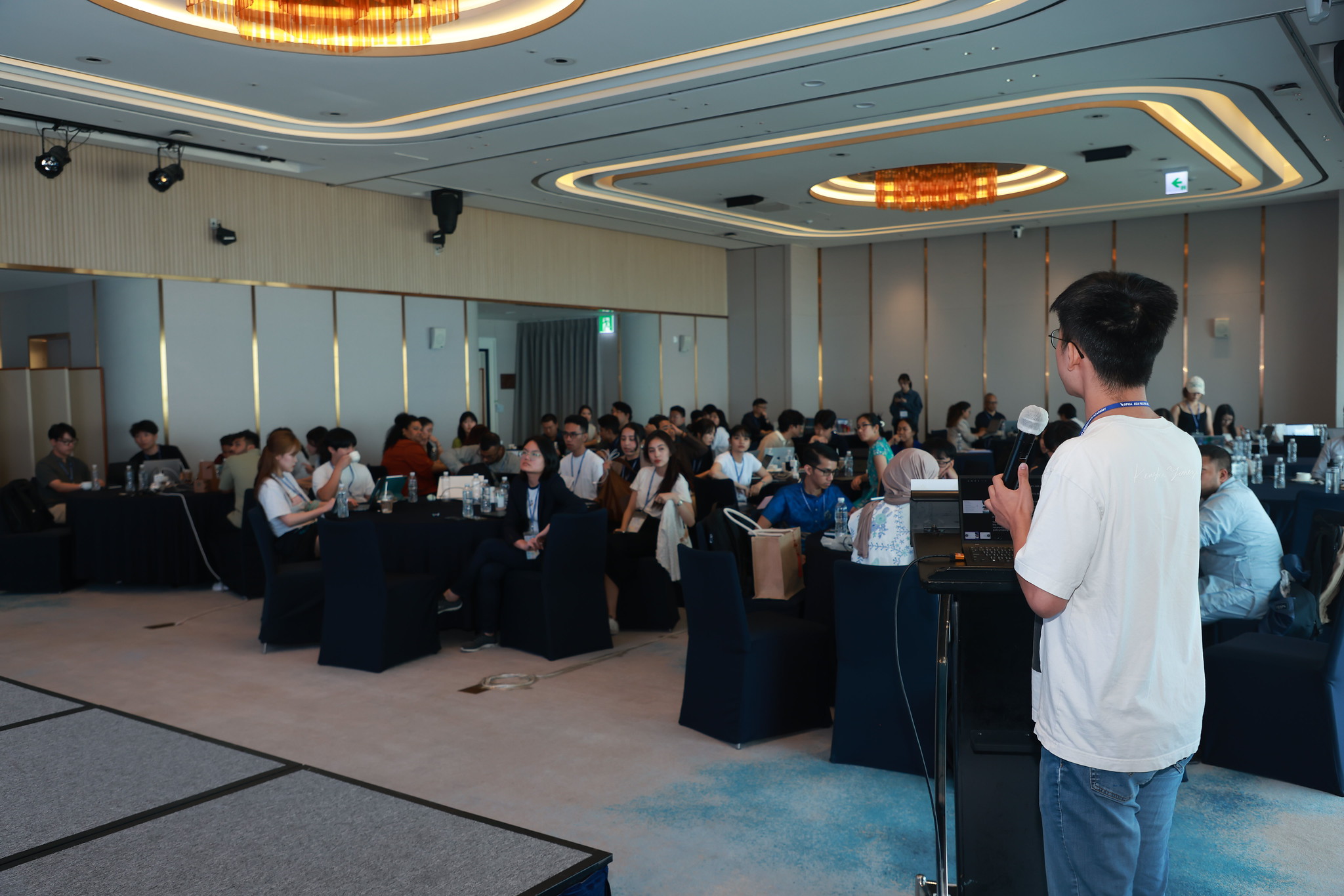
The main room in the Grand Josun, where most of our activities were held.
Day 5: Model ICANN Conference
For me, the highlight of APIGA Australia 2024 was the Model ICANN Conference, and APIGA was no different. For the past four days, in between all of the other activities, each of the delegations had been working hard to put together their individual and group stances. For this model conference, there were two problem statements that were in discussion:
- Should DNS Abuse be addressed before the launch of the Next Round of new gTLDs, and if so, to what extent?
- Should the Next Round of new gTLDs adopt a phased rollout, with the initial application phase limited to specific types of TLDs to help manage increasing DNS abuse?
Coincidently, this was not too dissimilar from the problem statements that I had previously considered at APIGA Australia the year before. However, that past experience was not all that helpful, as I had previously represented the EU in the GAC, whereas this time around, I was representing the EURALO Individuals’ Association, as a member of the wider ALAC group. This meant that I had a different stance on the topic, favouring the protection of individuals while carefully balancing it against the importance of creating and fostering communities on the internet.
The discussion was lively and engaging, with different representatives putting forward their views, and then having to find an acceptable compromise with the other parties. It was the perfect opportunity to put to use all of the information that we had learned in the past few days. At the end, all three groups were able to reach a rough consensus on the first problem statement, but we were not able to reach a consensus on the second problem statement. According to the mentor-experts, this was not hugely surprising, as we were essentially trying to negotiate something in a few hours, when it often took days or weeks of consideration in the real-world!
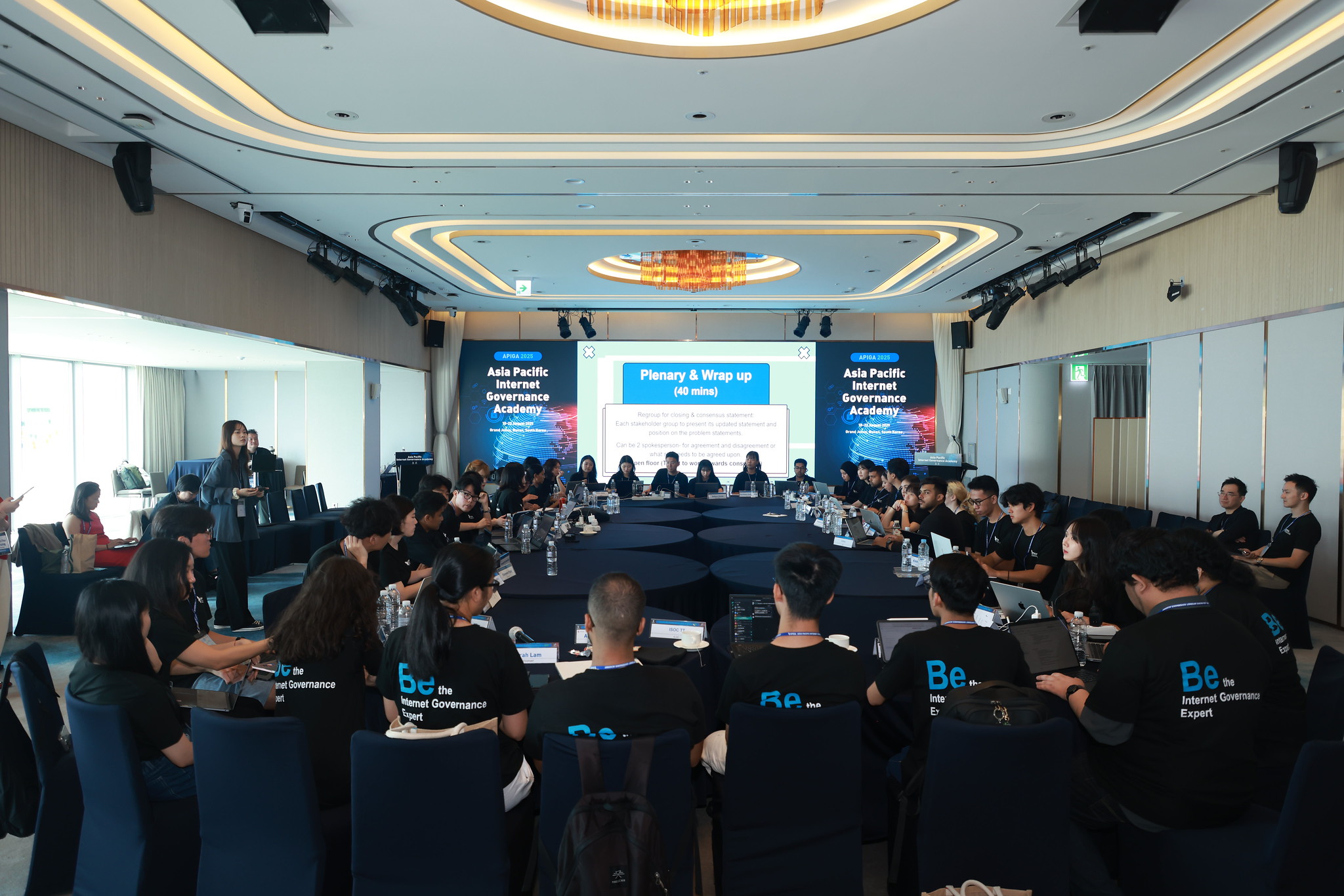
The tables were re-arranged for the Model ICANN Conference. Everyone was seated with their respective delegation and had placards in front of them, so that everyone could see who you were representing.
Once the model conference was complete, a closing ceremony was held. I was surprised and honoured to be awarded the prize for the ‘Best Leader’, as chosen by the mentor-experts. We then had the rest of the day off to go on a field trip on Busan’s iconic Haeundae Blue Line Park, a beautiful scenic train ride along the coast. It was truly a fantastic way to end the conference.
Conclusion and Thank You
APIGA 2025 was one of the best experiences I have had, and I enjoyed every moment of it. For any young person interested in internet governance, I would highly recommend applying for the next APIGA, or even a local APIGA (like APIGA Australia). But for me, the true value of APIGA 2025 was not in just learning about internet governance. It was in being able to meet other young people who came from all across the Asia Pacific region. Hearing their stories, and how they use the internet in their daily lives, made me realise how important the internet has become in modern life. It also made me realise that despite its importance, access to the internet is not equal, and this can have serious, tangible effects on communities.
In the metropolitan areas of Australia, accessing the internet is as easy as jumping onto a WiFi network or using mobile data. In just a click, we have access to global communication channels, enormous amounts of information and numerous services, some of which are essential for day-to-day life. However, in regional areas, this is not always the case. In more remote locations, access to the internet might be intermittent, or even non-existent. This isn’t just an Australian problem though. Unequal access to the internet is a global issue, with some countries having far less consistent access than others, whether due to government policies, geographic restrictions or technical limitations. Because of this, some people remain unable to access the things we take for granted, like instant messaging or online banking. This literal disconnect figuratively disconnects these people from others, and places them at a disadvantage in this inter-connected world. I think that, going forward, this will continue to be a topic of discussion in the internet governance world, particularly with the rise of the ‘splinternet’ phenomenon.
Finally, a huge thank you must go out to all of the people who worked so hard to bring APIGA 2025 to life. To the team at KISA, the youth leaders, all of the internet governance experts and everyone else, thank you so much for putting together this amazing program. I hope that it continues for many more years, so that it can continue to inspire the next generation of internet governance leaders.